
Vlad Zghurskyi
11.03.2026
10 Min Read
TL;DR
European media M&A in Q4 2025 was defined by de-conglomeration and AI-driven advertising consolidation. The most notable move was the Vivendi breakup into four entities, restructuring assets including Canal+, Havas, Hachette, and Vivendi in France. Meanwhile, Publicis Groupe acquired Mars United Commerce to strengthen retail-media algorithms, and Mediawan integrated Leonine Studios to build a European content hub competing with global streaming platforms. The quarter signals a shift toward AI-native media operations and specialized media ecosystems.
Mini-Glossary
Retail Media
Advertising that occurs directly within e-commerce platforms or retail ecosystems using first-party consumer data.
C2PA (Content Provenance and Authenticity)
A technical standard designed to verify the origin and authenticity of digital content, helping prevent deepfakes and manipulated media.
Conglomerate Discount
A reduction in market valuation that occurs when a diversified company is valued less than the combined value of its individual business units.
Generative Advertising
AI systems capable of automatically creating marketing visuals, text, or video content tailored to specific audiences.
Newsroom Automation
Use of AI tools to assist journalists in tasks such as content generation, data analysis, and automated reporting.

Key Deals
Deal Rationale
De-conglomeration strategy dominated the European media landscape. Vivendi split its assets to remove the traditional conglomerate discount and allow each unit to pursue independent growth strategies.
The Axel Springer restructuring separated profitable classifieds assets (backed by KKR with an estimated €13.5B valuation) from its AI-driven newsroom division.
Advertising networks are consolidating data capabilities. Publicis’ acquisition of Mars United Commerce strengthens retail-media algorithms and FMCG data analytics.
Meanwhile, Mediawan and Leonine Studios aim to create a European production hub capable of competing with global streaming platforms like Netflix.
Market Trends
European media is shifting from large conglomerates toward specialized media companies.
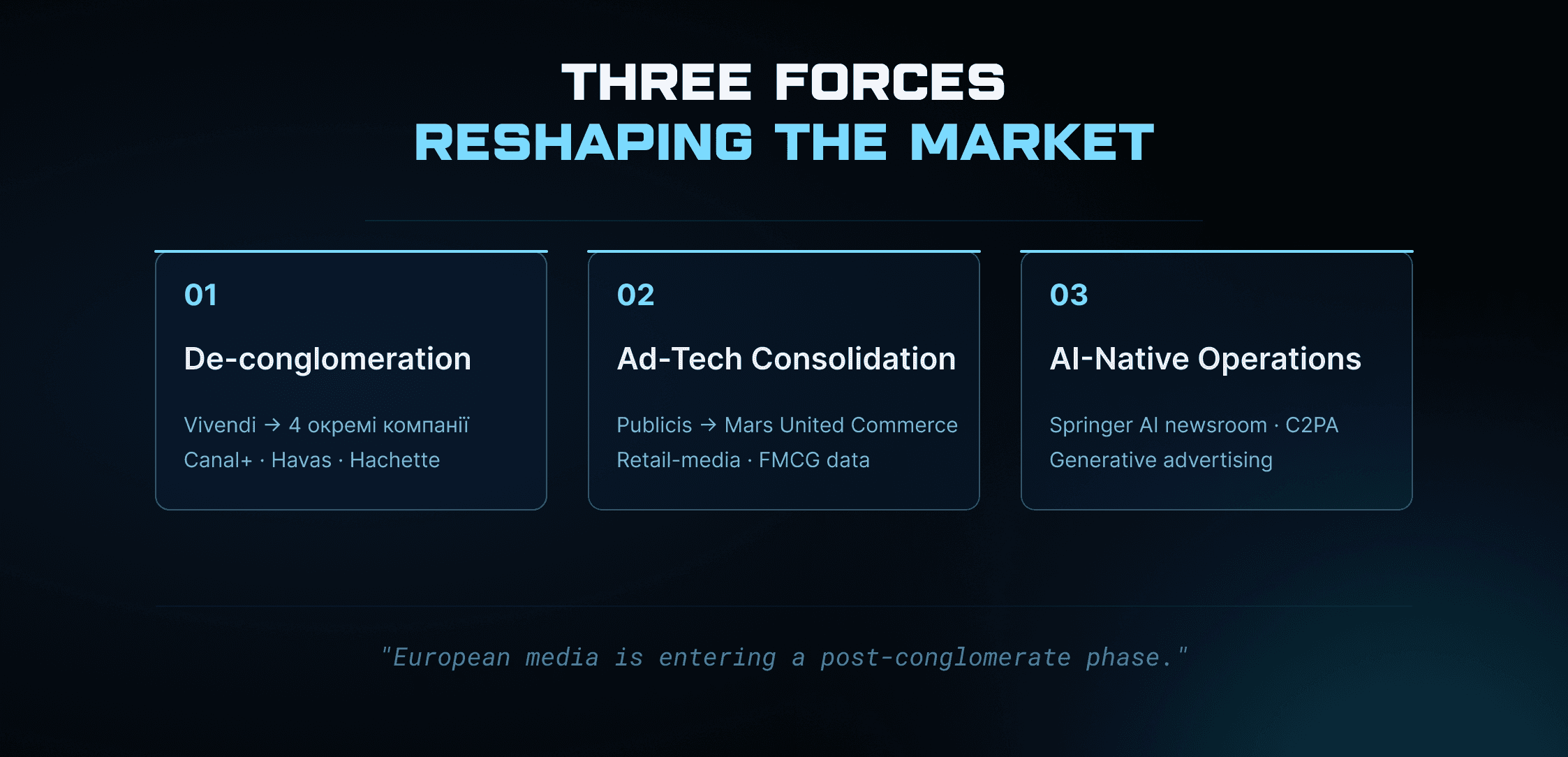
Three structural trends are visible:
Ad-tech consolidation, led by Publicis and WPP acquiring smaller data-driven advertising startups.
Content scale through acquisitions, with companies like Mediawan building regional production networks.
AI automation, particularly in advertising generation and newsroom operations.
AI-generated content and algorithmic advertising increasingly shape deal strategy across the sector.
Structured Signals
Signal Card | Description | Context | Confidence |
WPP AI bolt-ons | Generative video advertising startups | UK / Netherlands competition vs Publicis | Medium |
EBU Watermarking | C2PA deepfake protection | Reuters / AFP infrastructure integration | Medium |
KKR StepStone | Classifieds EBITDA exit strategy | Springer restructuring | High |
Analyst Thesis
European media is entering a post-conglomerate phase.
Companies are restructuring around core capabilities:
Havas → data and marketing technology
Canal+ → premium content production
Springer → AI-driven digital news
The advertising market is consolidating into a data-driven oligopoly, while content companies are building scale to compete with global streaming platforms.
Simultaneously, deepfake detection and media authenticity systems are likely to become a major investment area by 2026, pushing the media industry toward cyber-forensic infrastructure.
What Changed in Q4 2025
Structural shift toward de-conglomeration across major European media groups.
AI-native content production began shaping M&A strategies.
Ad-tech consolidation accelerated, reinforcing the dominance of large advertising networks.
Sources Hierarchy
Tier 1 — Primary sources
Corporate press releases
Regulatory filings
Investor reports
Tier 2 — Financial media
Reuters
Financial Times
Bloomberg
Tier 3 — Industry research
PitchBook
Crunchbase
Venture capital market data
Confidence Framework
High Confidence
Deals confirmed by official company disclosures or regulatory filings.
Medium Confidence
Reported by major financial media but not yet confirmed by all parties.
Low Confidence
Early-stage negotiations or unverified market signals.

FAQ
What were the largest media M&A developments in Europe in Q4 2025?
The most important developments included the Vivendi corporate breakup, Publicis acquiring Mars United Commerce, and Mediawan integrating Leonine Studios to expand European film production.
Why did Vivendi break up its media businesses?
The restructuring allows each business unit to pursue independent growth strategies while eliminating the conglomerate discount that previously suppressed the company’s valuation.
Why are advertising companies acquiring retail-media platforms?
Retail-media platforms provide access to first-party consumer purchasing data, which is becoming essential for targeted digital advertising.
How is AI affecting the media industry?
AI is increasingly used to generate advertising creatives, assist journalists with automated reporting, and personalize digital media content.