
Content List
What’s Happening in the Ukrainian MilTech Market
Vlad Zghurskyi
19.01.2026
15 Min Read
The Ukrainian defense industry has undergone a transformation that no traditional defense economy has ever replicated in such a short time.
What began as a chaotic ecosystem of volunteer engineers and small R&D teams has matured into an industrial complex shaping the future of unmanned systems, electronic warfare, and battlefield software. In this article, we’ll break down what changed so far, where the market stands now, and why Ukraine’s defense innovation is becoming one of the most important forces in global security architecture. Keep reading.
Why Ukraine’s Defense Boom Matters Now?
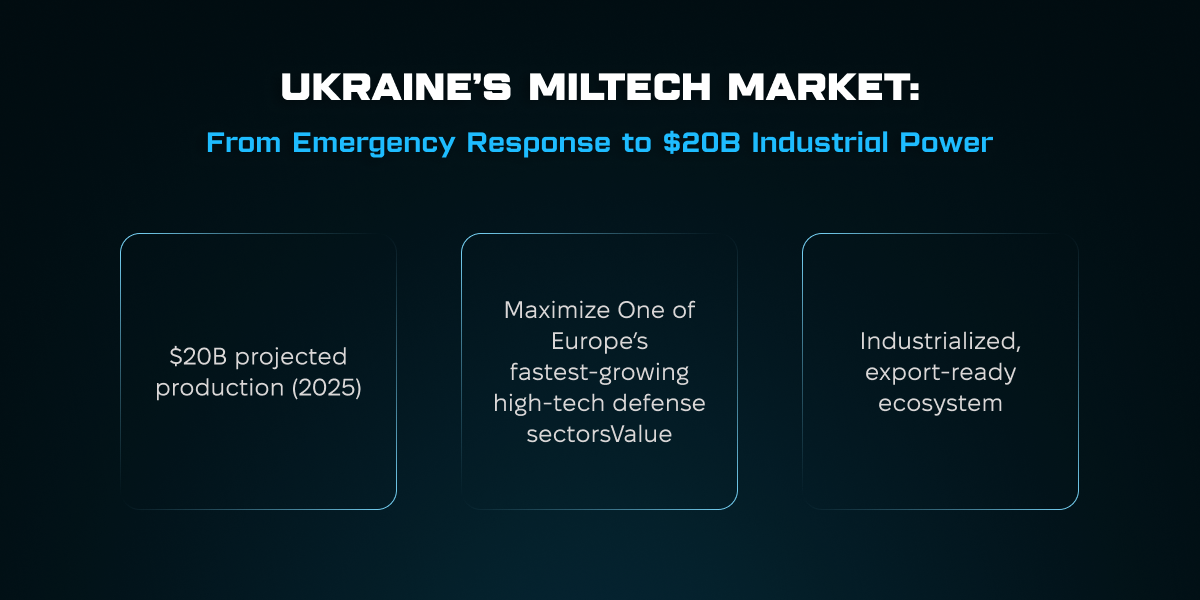
Ukraine’s defense market is no longer an emergency response mechanism. It has evolved into a structured, industrialized, and export-ready ecosystem. With projected production volumes of $20B in 2025 and unprecedented growth in unmanned systems, EW, C2/C4ISR, cyber, and logistics tech, the Ukrainian defense sector is now one of the key global centers of high-tech defense innovation.
Ukraine’s defense industry has quietly become one of the most dynamic high-tech sectors in Europe.
The shift from bottom-up volunteer solutions to a consolidated, professionally governed ecosystem is reshaping procurement, manufacturing, supply chains, and cooperation between startups, state-owned enterprises, and international partners.
From Volunteers to Market
To understand Ukraine’s defense boom, you have to understand where it started.
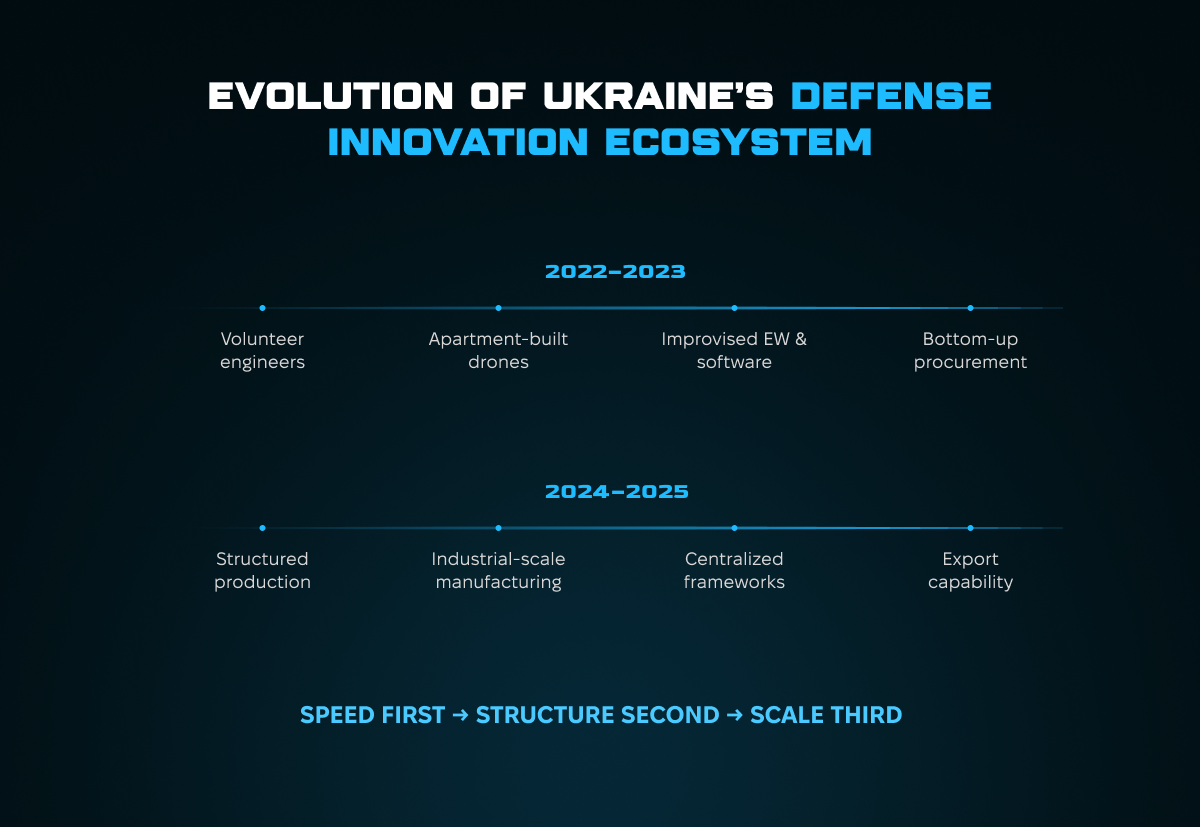
In 2022–2023, the ecosystem was defined by desperation and speed. Small teams were building drones in apartments, improvised EW devices on the fly, and writing battlefield software overnight simply because Ukrainian military units needed working solutions right now.
This improvisational phase was the earliest form of Ukraine’s defense innovation ecosystem. It was decentralized, chaotic, and extremely fast. Companies weren’t “companies”; they were clusters of engineers responding to urgent battlefield needs.
Procurement was bottom-up; military units purchased whatever worked, regardless of governance or scaling potential. It was a time defined by necessity rather than strategy, but it laid the foundation for what became the most adaptive defense technology sector in the world.
What Changed by 2025 in the Ukrainian Miltech Market
By 2025, Ukraine’s defense industry did something rare: it matured while still fighting a full-scale war. The ecosystem transitioned from rapid prototyping to industrial production, from improvised procurement to structured frameworks, and from volunteer labs to sophisticated manufacturers capable of exporting globally.
Therefore, today we see the following things:

Structured Demand
- The Ministry of Strategic Industries
- The Ukrainian Council of Defence Industry (UCDI)
- Centralized and decentralized procurement programs
- Foreign governments and international defense holdings that now source Ukrainian technologies
This structure allows the defense industry to budget, plan, scale, and integrate technology development into long-term national security priorities. Clear priorities mean manufacturers know exactly which products military units need and what standards they must meet.
Growing Exports
- Battlefield validation in extreme EW conditions
- Shorter R&D cycles
- Competitive pricing
- High resilience and operational reliability
For many countries, Ukrainian systems offer something Western manufacturers cannot replicate: technology born from real-time deployment and immediate battlefield feedback loops.
Export Frameworks
- Simplified export licensing
- Dual-use export procedures
- Special frameworks for unmanned systems
- New certification pathways
- Cooperation tools between Ukrainian and foreign suppliers
These frameworks help accelerate agreements, remove bottlenecks, and consolidate Ukraine’s industrial complex.
NATO/EU Programs
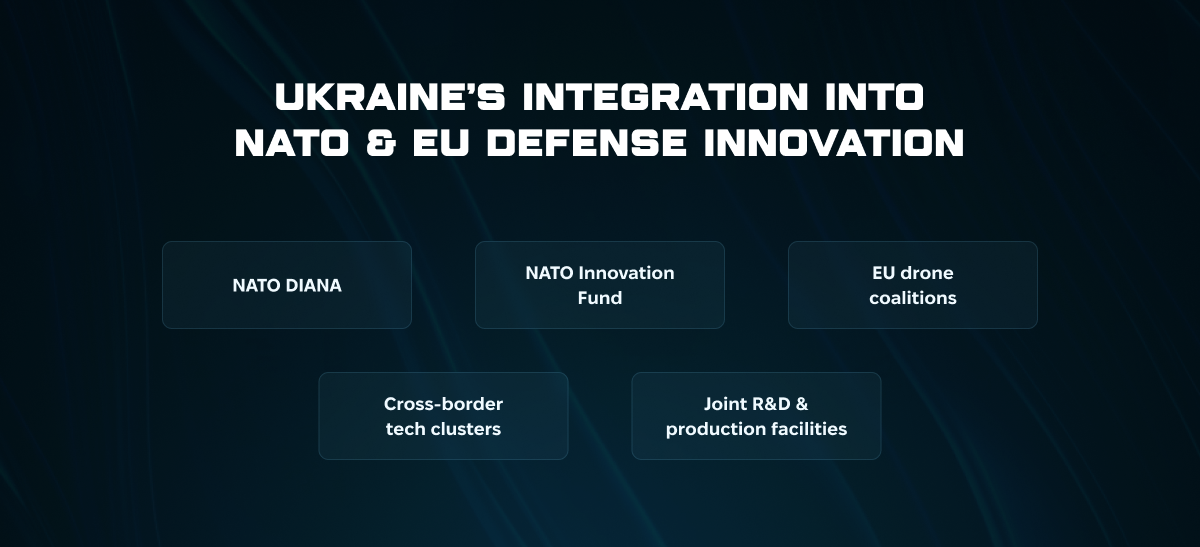
This brings Ukrainian manufacturers closer to Western procurement standards and new markets.
Key Subsectors in UA DefenseTech Niche
Ukraine’s defense innovation is not a single direction but a multi-layered industrial complex built under full-scale wartime pressure. Each subsector evolves at extreme speed because real battlefield feedback loops shape product development daily. The result is an ecosystem where drones, EW, software, cyber, logistics, and energy technologies are tightly integrated rather than isolated verticals.
Drones
Unmanned systems are the backbone of Ukraine’s defense innovation ecosystem. No other country has produced, tested, and iterated drone technology at such scale and speed under real-time conditions. The combination of 500+ manufacturers, FPV specialization, and high-intensity EW pressure has turned Ukraine into the global R&D center for unmanned systems.
- FPV drones optimized for jamming-heavy environments
- Reconnaissance UAVs with long endurance and real-time situational awareness payloads
- Strike platforms, including heavy unmanned systems
- AI-powered autonomy and battlefield robotics
- Ukrainian-made avionics, software, and anti-jam modules
Electronic Warfare & Counter-UAS
EW has become one of the key differentiators of Ukraine’s battlefield advantage. The country fights on the most electronically contested battlefield in modern history, forcing engineers to build resilient systems, spectrum tools, and countermeasures that constantly evolve. This makes Ukrainian EW and C-UAS solutions deeply competitive in new markets looking for proven systems.
- Portable EW suites for small teams and decentralized units
- Counter-drone weapons and multi-layered C-UAS architectures
- Spectrum analysis, jamming, and signal intelligence tools
- Hybrid cyber + EW systems that integrate into situational awareness dashboards
- Rapid-deployment EW modules for frontline mobility
C2/C4ISR & Software
Ukraine’s software-driven command-and-control systems have become one of the most strategically important assets in the country’s defense industry. Small engineering teams built digital C2 tools capable of integrating drones, sensors, artillery, and EW into a single situational awareness system. These platforms have shifted Ukraine from reactive defense to data-driven, networked warfare.
- Real-time battlefield dashboards
- AI-powered targeting and automated decision-support tools
- Secure communication systems based on modern encryption
- Integrated fire control and reconnaissance coordination platforms
- Battlefield digital twins and simulation engines
- Friend-or-foe (IFF) recognition systems
Logistics / Medtech / Energy
Ukraine’s support technologies have a vital function: reduce casualties, increase resilience, and ensure that Ukrainian military units have the products they need without delays.
- Robotic logistics and unmanned ground vehicles
- Real-time battlefield dashboards
- AI-powered targeting and automated decision-support tools
- Secure communication systems based on modern encryption
- Integrated fire control and reconnaissance coordination platforms
- Battlefield digital twins and simulation engines
Cyber & Information Operations
It is a pillar of Ukraine’s security architecture that was vital even before the start of full-fledged war. Since 2014, Ukrainian cyber teams have defended national systems from constant russian attacks, creating a hardened environment where cyber defense, offensive response, and information operations are tightly combined.
- Defensive cyber infrastructure
- Secure comms for military personnel
- Offensive cyber capabilities and automated exploit frameworks
- OSINT-driven intelligence platforms
- Information operations tools used for narrative defense
This is one of the few cyber ecosystems globally built under uninterrupted real conflict, making Ukrainian cyber tools uniquely resilient and export-ready.
Opportunities for International Partners
Ukraine’s defense innovation ecosystem is not looking for sponsors anymore. Rather, it is seeking strategic partners who can accelerate scaling, integration, and access to global markets.
1
Joint R&D and Technology Development
Western engineering + Ukrainian battlefield-tested prototypes = globally competitive systems.
2
Components and Supply Chains
Ukraine aims to localize 60–80% of NATO-grade components by 2025, creating significant openings for suppliers.
3
Certification, Market Access, Localization
Partners can help Ukrainian-made products integrate into NATO procurement, compliance, and testing frameworks.
4
M&A, Strategic Investment, and Consolidation
As the sector scales, both startups and manufacturers will look to consolidate or bring in strategic investors.
Mergewave’s Lens
As we look back on 2025 and ahead toward 2026, it’s clear that Mergewave Capital is stepping into this new chapter with a sharper perspective. Over the past year, our team has reassessed the trajectory of the miltech sector and made a deliberate decision to reenter the market with renewed focus and conviction.
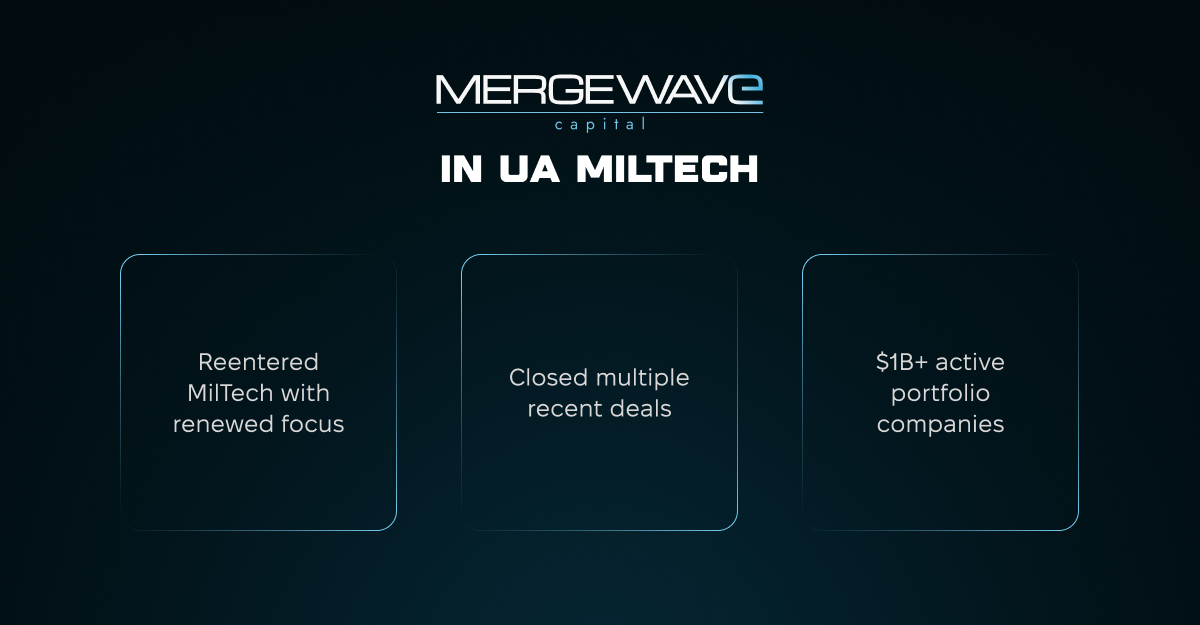
It was a response to what we were seeing on the ground: a rapidly accelerating demand for dual-use technologies, founders pushing the boundaries of defense innovation, and an environment where capital paired with operational expertise can unlock outsized impact.
Since returning to the space, we’ve already closed several significant deals. Our portfolio alone now includes more than $1B+ in active companies, a milestone that reflects both the pace of the industry and the discipline of our investment approach.
Future of Ukrainian Miltech Market
The next decade of Ukraine’s defense industry will be shaped by integration, autonomy, AI-driven systems, and joint production.
- Integrate drones, EW, AI, and cyber into unified architectures
- Build export-ready products
- Partner with Western suppliers
- Scale through consolidation
- Leverage dual-use potential in robotics, cybersecurity, energy, and software
We help MilTech companies raise capital, scale through strategic acquisitions, and exit on their terms. Whether you’re building battlefield-tested tech or running a global defense operation, your next successful transaction starts now.

Key takeaways
Ukraine’s defense sector has matured rapidly since 2022, moving from volunteer initiatives to a structured MilTech market.
Drones, electronic warfare, C2/C4ISR, and cybersecurity represent the most dynamic subsectors.
Export frameworks and NATO/EU programs facilitate international cooperation and investment.
Mergewave’s portfolio demonstrates the scale and potential of active Ukrainian MilTech companies, with over $2B in active investments.
- For investors and partners, Ukraine offers a rare combination of rapid innovation, operational credibility, and global market access.
FAQ
What is driving the rapid growth of Ukraine’s MilTech market in 2025?
Ukraine’s MilTech growth is driven by real battlefield demand, accelerated R&D cycles, and constant frontline feedback. Technologies are developed, tested, and refined under live combat conditions, allowing companies to iterate faster than in traditional defense markets.
Is Ukraine’s defense industry still based on volunteer initiatives?
No, the sector has moved beyond its volunteer roots. By 2026, it operates as a structured, industrialized ecosystem with centralized demand, professional governance, and scalable manufacturing.
Which MilTech subsectors are growing the fastest in Ukraine?
The fastest-growing subsectors include unmanned systems, electronic warfare, C2/C4ISR software, and cybersecurity. Logistics, medtech, robotics, and energy systems are also scaling rapidly due to battlefield-driven demand.
#M&A
#ukraine
#nato
#eu
Share this post
Ready to grow?
With our M&A expertise we are ready to help you achieve your strategic goals!
Connect with us