
Content List
Exit Strategies For IT Business Explained
Vlad Zghurskyi
17.01.2026
10 Min Read
Growth stories in IT usually take up all the space. Funding rounds, new clients, expanding teams – all that seems to be about progress. But smart entrepreneurs know that how you exit a business can matter even more than how you build it.
A good exit strategy is not a simple plan to sell your business or cash out. It’s a blueprint that aligns your personal and business goals, safeguards your team, and gives your company’s legacy a chance to grow under the right new owner.
So maybe you’re a startup founder, an established business owner, or part of a profitable IT firm preparing for a transition; in any case, your exit plan deserves as much attention as your business plan.
Let’s walk through what an exit strategy in business really means, and explore the top 5 exit strategies for IT businesses
What is a Business Exit Strategy?
A business exit strategy is a structured plan that defines how an entrepreneur, investor, or founder will exit a business. Maybe through transferring ownership, realizing returns, or winding down operations.
In simple terms, it’s your roadmap for leaving the company and maximizing the value of the business. The exit process can take many forms, from selling to a selling to a strategic buyer, private equity firm, larger competitor, or another type of financial investor, depending on market conditions and the structure of the deal
Having a strategy in place allows owners to prepare for shifts in market conditions. Plus, this is how you maintain stability for employees and customers during the transition.
Top 5 Exit Strategies For IT Business
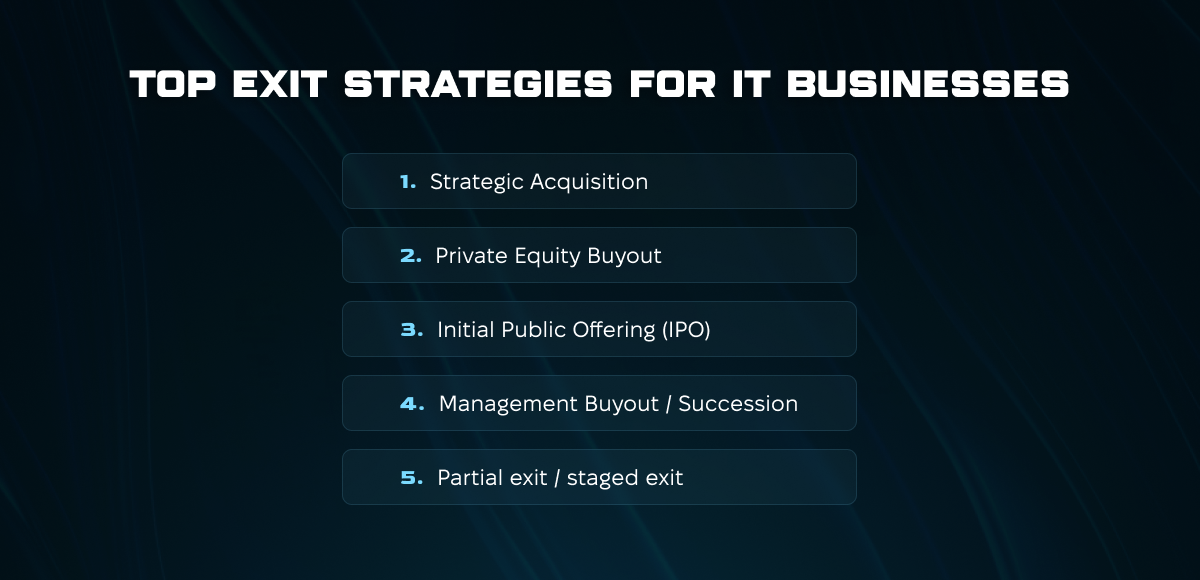
So what are the best options for IT owners? Let’s find out.

Strategy 1: Strategic Acquisition
The classic choice.
A strategic acquisition happens when a larger company buys your business because it strengthens their offering, expands their market, or adds key technology. These deals often bring premium valuations because the buyer is acquiring synergy.
A good example is Google’s acquisition of Looker to enhance its cloud analytics or Cisco’s consistent acquisition streak in cybersecurity. Both are nothing but textbook examples of successful exits driven by technology fit and growth potential.
- Established players constantly scout innovative startups to stay ahead.
- Integration potential often boosts the business valuation.
- Founders may remain in leadership or advisory roles post-acquisition.
- “Acqui-hiring” (buying for talent and IP) is resurging, especially in AI and deep tech.
A strategic acquisition can deliver high liquidity and allow you to exit your business.
Strategy 2: Private Equity (PE) Buyout
A private equity buyout is often misunderstood as a “sell-out.” In reality, it’s one of the most effective exit strategies for mature IT companies.
Here, a PE firm buys a controlling stake in your business. Not to strip it down, but to scale it up. These firms bring capital, operational expertise, and networks to increase efficiency and prepare for another type of exit, such as an IPO or secondary sale.
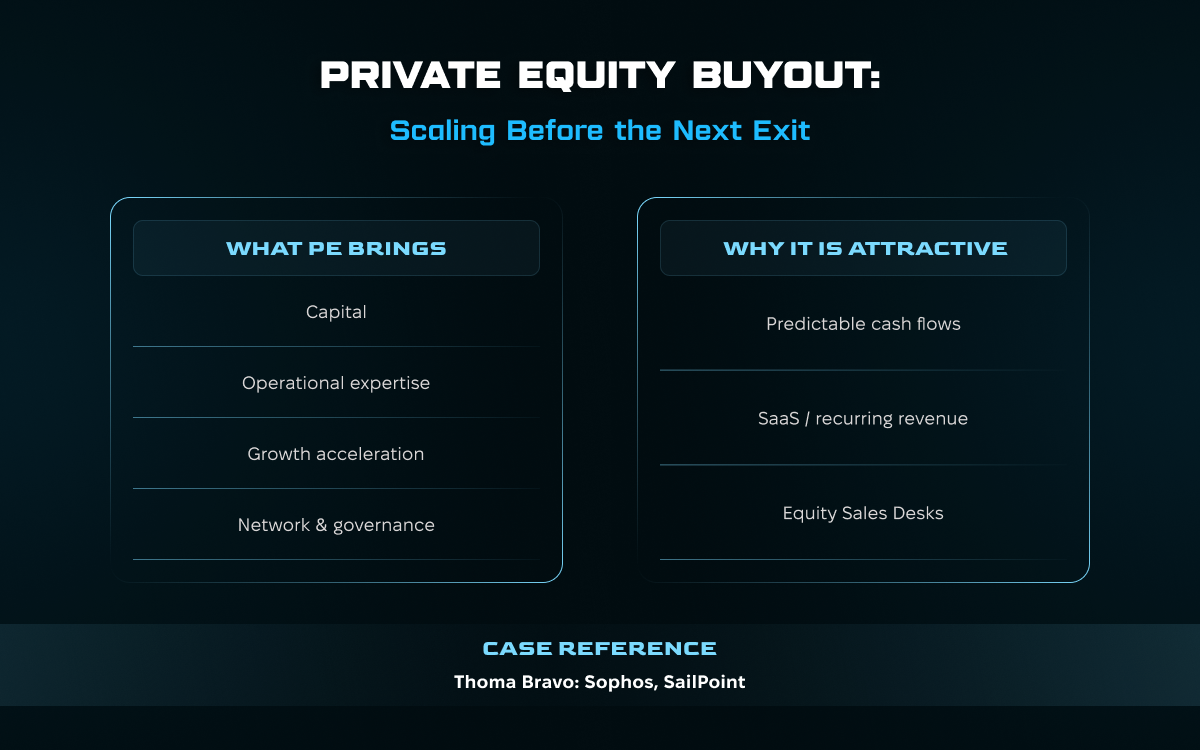
Take Thoma Bravo, one of the leading names in tech-focused private equity. Their acquisitions of Sophos and SailPoint are case studies in how PE can turn strong IT companies into billion-dollar performers through strategic restructuring and growth acceleration.
- Predictable cash flow models like SaaS or managed IT services attract PE investors, especially when revenue is recurring and contract-based.
- You can partially sell your business but stay operationally involved.
- PE provides access to capital and growth partners for global expansion.
For founders who’ve built a profitable business but need support to develop a business beyond their limits, this exit option can be a win-win.
Strategy 3: Initial Public Offering (IPO)
Going public is the dream of many entrepreneurs. It is one of the most visible and prestigious types of exit strategies.
An initial public offering allows you to sell shares of your company to public investors. The main advantage is that you open up massive liquidity while maintaining partial ownership. For IT businesses with strong growth, brand reputation, and scalable operations, an IPO can deliver a clear exit that maximizes business value and credibility.
For instance, Snowflake’s IPO in 2020 was a landmark event. Its data cloud model attracted institutional investors, and its market value soared past $70 billion. It showed that business owners may reach unprecedented valuations when they plan their exit strategy right and choose the right market timing.
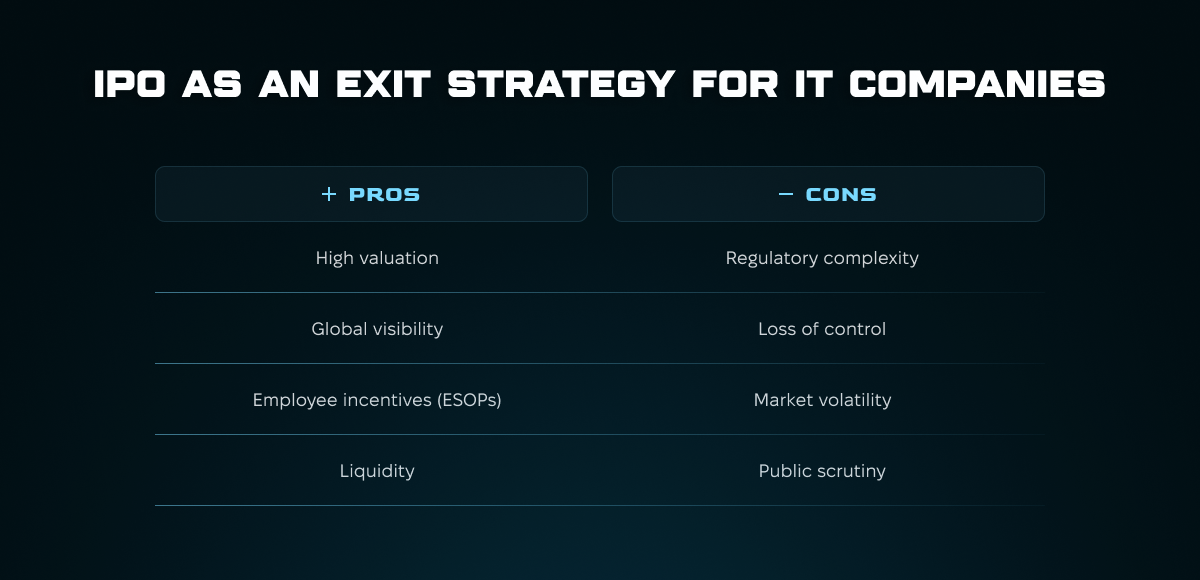
Important: An IPO is not suitable for every type of business, but for scalable IT enterprises, it’s one of the best exit strategies when growth potential outweighs the risks.
Strategy 4: Management Buyout or Succession Plan
Some exits are built on continuity and trust.
A management buyout happens when your internal team (aka those already familiar with the business) buys it from you. Similarly, a succession plan allows you to transfer ownership to a family member, co-founder, or senior executive, ensuring the business continues without disruption.
- Maintains company culture and client relationships.
- Smooth transition with minimal operational risk.
- You can plan for your personal and business goals while ensuring long-term stability.
- Valuation can become a sticking point, especially when founders and buyers see the company’s future potential differently.
This type of exit suits founders who want to pass their company to trusted hands rather than selling to an external buyer. It’s also a common exit strategy business plan for small to mid-sized IT firms with strong internal leadership.
Why Do You Need an Exit Strategy for IT Business?
Many business owners build brilliant products but never plan for your business beyond daily operations. Yet, having an exit strategy in place is one of the smartest business decisions you can make.
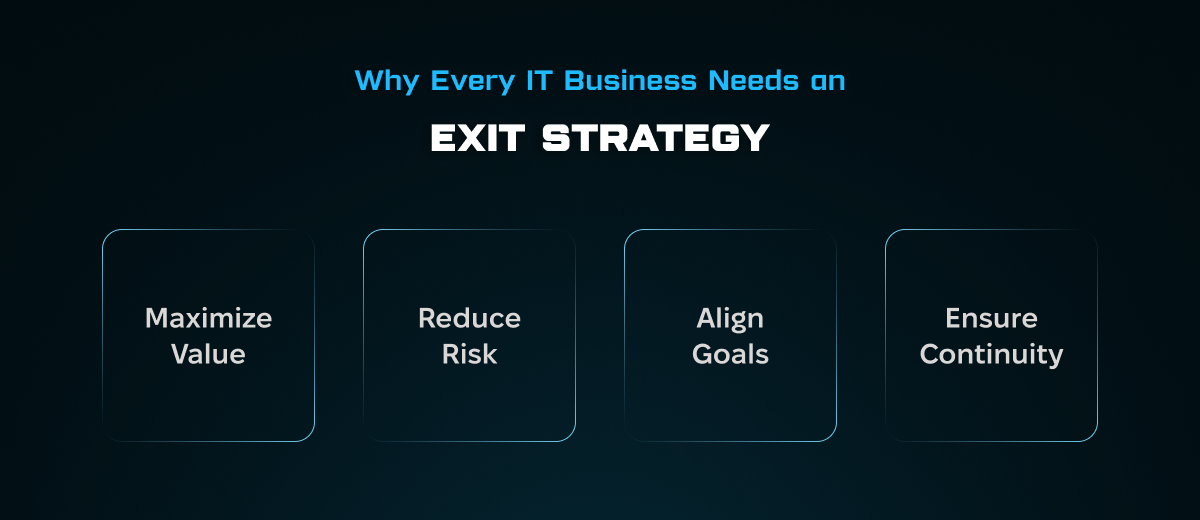
1
Maximize Value
An exit strategy positions your company for a stronger market value before negotiations even begin. By planning early, you can highlight metrics that matter and structure your operations for premium valuation when potential buyers come knocking.
2
Reduce Risk
A clear exit plan helps you time your move based on favorable market conditions. It reduces legal, tax, and operational risks while giving you the flexibility to exit on your own terms.
3
Align Goals
A clear exit ties together your personal and business goals, ensuring a smooth and meaningful transition. Whether you’re eyeing retirement, a new venture, or simply more freedom, alignment helps you exit strategically rather than emotionally.
4
Ensure Continuity
A solid exit process keeps your employees and customers confident during change. It ensures the business continues to run smoothly, maintains trust, and preserves long-term value.
How To Choose The Right Strategy
The exit strategy you choose depends on your business type and size, growth stage, and business performance. Ask yourself:
- Do I want to stay involved or fully leave the business?
- Is my business valuation where I want it to be?
- Who are my potential buyers?
- What does the exit value need to support my next venture or retirement?
You should also consult with financial advisors, M&A experts, and legal professionals who can assess market conditions, tax implications, and your strategy provides long-term sustainability.
Remember: a successful exit starts years before you plan to sell the business.
How Can We Help You Succeed?
At Mergewave Capital, with 8+ years on the market and over 70 closed deals, we know how to deliver value. We specialize in guiding IT founders and business owners through the complexities of business exit planning. Are you preparing for a merger, acquisition, or initial public offering? We help you create an exit that maximizes value and minimizes risk.
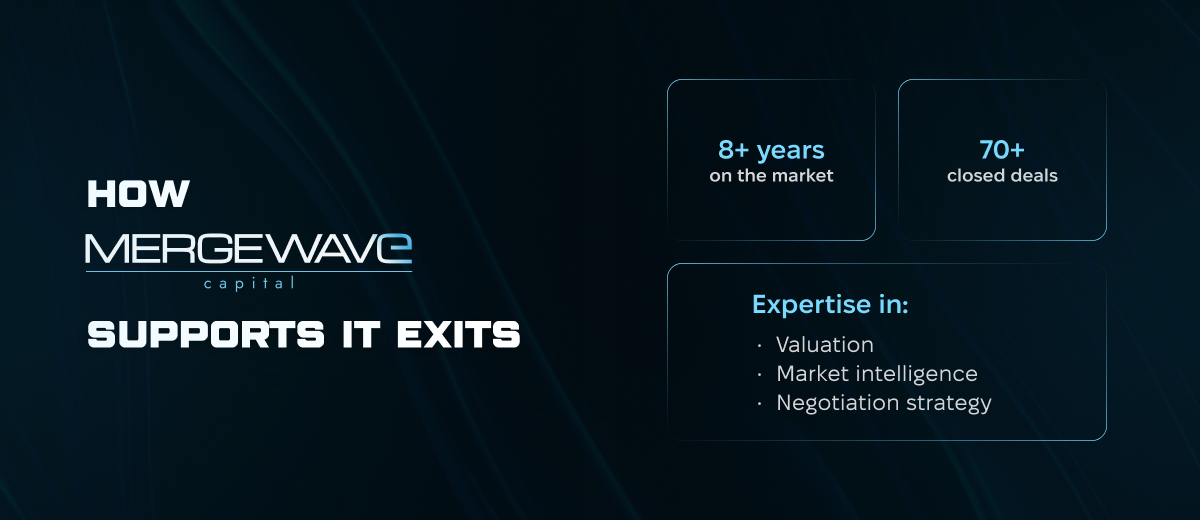
Our approach combines valuation expertise, market intelligence, and negotiation strategy to help you start your exit with confidence.
The best exits don’t have to start when a buyer appears. They start when owners design their business with long-term value in mind.
Mergewave Capital helps IT founders and business owners evaluate exit options, strengthen valuation drivers, and structure transitions that protect capital and legacy.
Talk to our M&A advisory team to assess your exit readiness and build an exit strategy that aligns with your next chapter before the market decides for you.

Key Takeaways
A business exit strategy shouldn’t be considered a backup plan. It’s a growth strategy.
Different business exit strategies suit different goals.
Exit strategy planning can also help strengthen your current operations and grow your business.
Owners may achieve higher valuations and smoother transitions with early exit strategy business planning.
A clear exit is a sign of a confident, prepared entrepreneur.
FAQ
How can an exit strategy impact stakeholders and employees?
A thoughtful exit plan ensures that employees and customers are informed, protected, and motivated during ownership changes. It builds trust and continuity.
What are the key steps for planning a successful exit strategy?
Define your goals for your business, assess business value, research exit options, and engage experts early.
When is the right time to implement an exit strategy?
Now. An exit strategy is an important part of any business plan. The earlier you start creating an exit strategy, the better prepared you’ll be when opportunity or necessity arises.
#M&A
#exit
#strategy
#web3
Share this post
Ready to grow?
With our M&A expertise we are ready to help you achieve your strategic goals!
Connect with us