
Content List
Buy Side vs Sell Side in M&A Process Explained
Vlad Zghurskyi
16.01.2026
15 Min Read
In every merger or acquisition, there are two sides of the same coin — and they play fundamentally different games. A buy or sell-side analyst might seem to work with the same spreadsheets, but the context they operate in is very different. Buy-side M&A focuses on building strategies, exploring targets, and shaping deals that align with long-term growth. The sell-side, by contrast, operates in a world where the goal is to sell securities, position companies for investors, and create a competitive process that maximizes value.
This dynamic between the buy-side to the sell-side is what keeps the market moving. One side looks to deploy capital; the other prepares the ground for those investments to land. Together, the sell-side and buy-side of M&A create the engine room of financial markets, where transactions are pushed forward by competing priorities.
Let’s find out what the main distinctions are between these two
Key Differences Between Sell Side and Buy Side
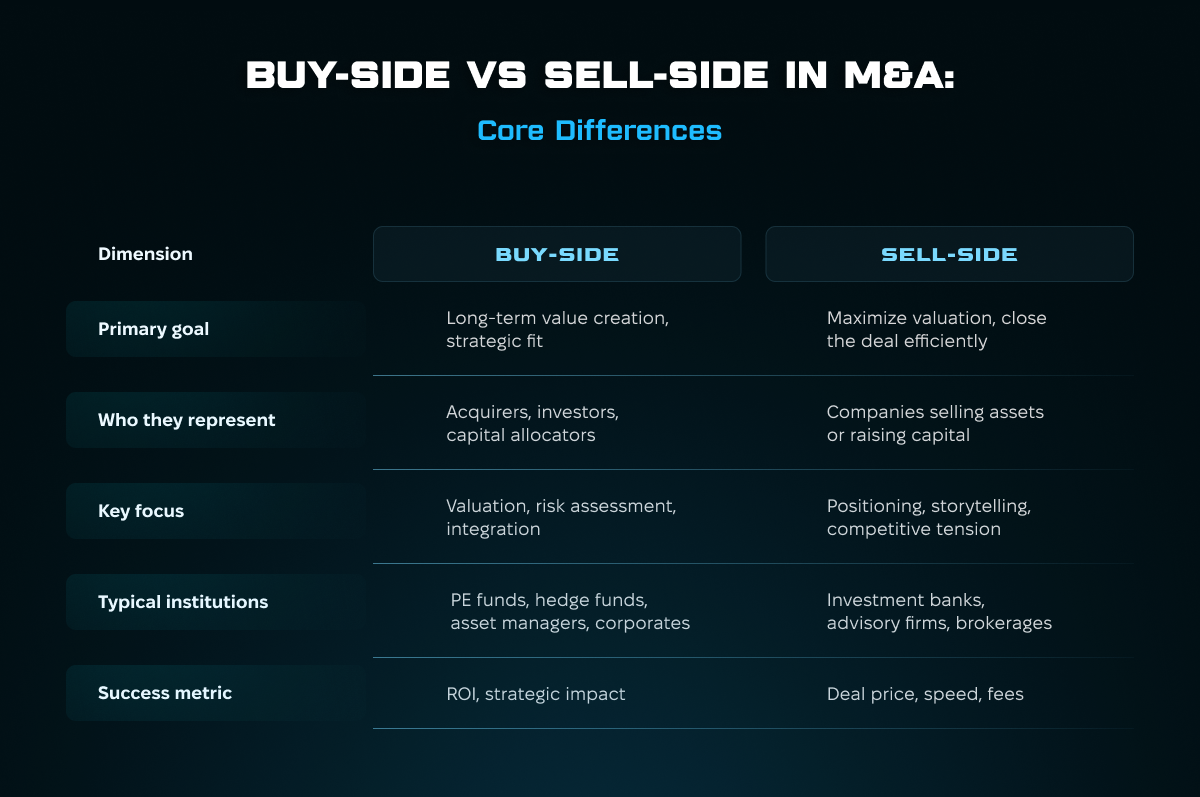
The contrast between buy-side and sell-side in mergers and acquisitions is about who they are, how they’re structured, and where their influence lands in the transaction.
On the sell side of the financial sales and trading, you’ll find investment banks, advisory firms, and brokerages. Their role is to sell securities, run structured processes, and create demand for the client’s assets. In sell-side in mergers and acquisitions, this means preparing the data room, crafting the equity story, and making sure that multiple bidders line up — because competition drives price.
The buy side of M&A is a different ecosystem. It includes private equity funds, hedge funds, asset managers, and corporate development teams. A buy or sell-side analyst on this side is charged with dissecting opportunities, spotting risks, and working out whether the transaction delivers long-term growth.
Buy-side M&A focuses not only on financial modeling but also on integration planning, making sure the acquisition fits the strategy of the portfolio.
This dynamic creates a natural push-and-pull: the sell-side refers to the entities that create opportunities and narratives, while the buy-side represents the capital that evaluates them. It’s the relationship between buy-side to the sell-side that ensures deals actually close. One prepares the stage, the other decides whether the play is worth the ticket price.
This buy-side vs sell-side split is the engine of the M&A market. But how does each look at the deeper level? Let’s find out.
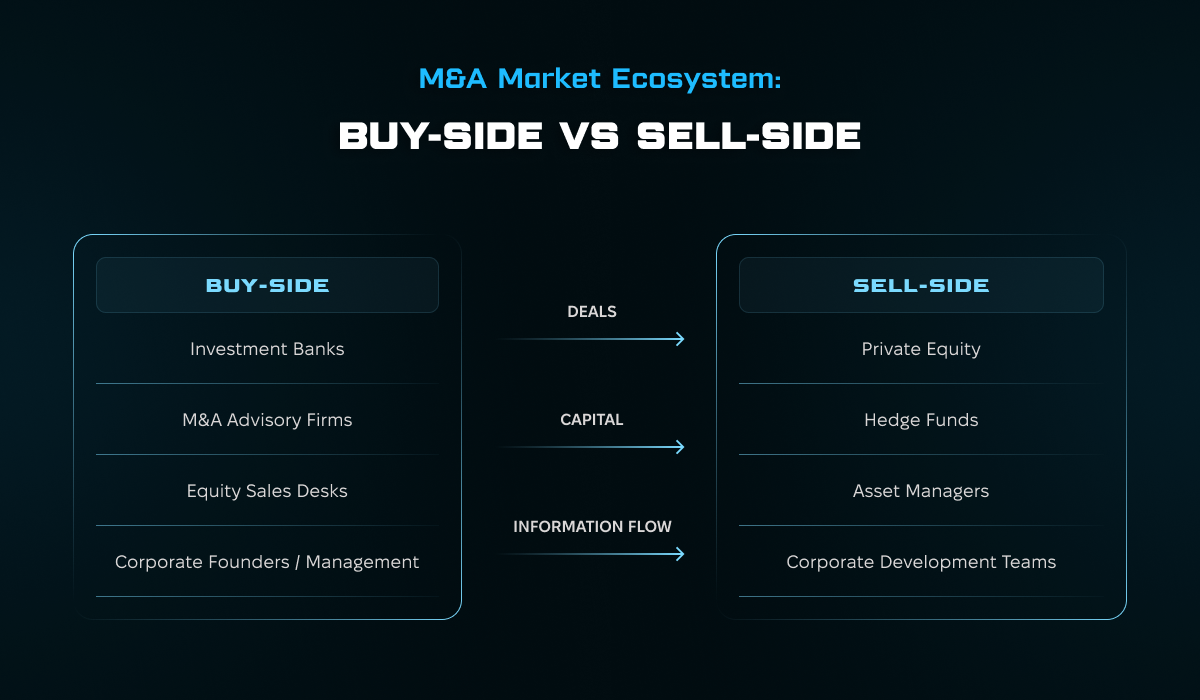
Buy Side in M&A
Definition
Buy-side in M&A refers to all activities, institutions, and professionals representing the acquirer in an M&A deal. These can be corporations, hedge funds, or buy-side investment banking teams whose mandate is to purchase securities, acquire companies, or expand portfolios.
Structure
- Corporate development teams (inside large firms).
- Equity professionals.
- Investment bankers advising on acquisition strategy.
- Buy-side analysts and associates conducting research, modeling, and valuation.
The buy-side builds the M&A model: assessing valuation ranges, projecting synergies, and determining how equity financing will shape the deal.
Role
Buy-side professionals identify targets, negotiate terms, conduct due diligence, and ensure the investment aligns with strategy. The emphasis is on minimizing risk while maximizing upside.
Institutions
- Private Equity (PE) funds – focusing on leveraged buyouts, growth capital, or minority stakes.
- Private investors – high-net-worth individuals or family offices seeking direct investment opportunities.
- Corporations (strategic buyers) – looking to expand market share, acquire technology, or enter new markets.
- Strategic acquirers – companies making acquisitions specifically to strengthen their competitive position.
- Asset managers and hedge funds – interested in targeted investment opportunities and portfolio diversification.
Motivations
- Strategic growth: Entering new markets or adding capabilities.
- Financial returns: Capturing undervalued assets or creating shareholder value.
- Portfolio balance: Diversifying risk and exposure across sectors.

Sell Side in M&A
Definition
Sell-side in M&A refers to activities and advisors representing the seller. This includes sell-side firms, investment banks, and advisory teams that prepare a company for sale and run the process.
Structure
- Corporate executives or founders looking to exit.
- Sell-side advisors and bankers are preparing marketing materials.
- Legal and accounting professionals ensure compliance.
Sell-side in M&A transactions involves building the data room and engaging multiple buyers to create competition.
Role
- Position the company in the best light.
- Reach out to potential buyers.
- Negotiate terms that maximize valuation and minimize liabilities.
Sell-side firms work closely with management to highlight strengths while addressing potential risks.
Institutions
- Investment banks running structured auction processes.
- Advisory firms preparing valuations and fairness opinions.
- Equity sales desks handling placements of new shares when companies raise capital.
Motivations
- Raising capital (debt or equity).
- Divesting non-core divisions.
- Facilitating exits for founders or early investors.
Buy-Side vs Sell-Side Due Diligence
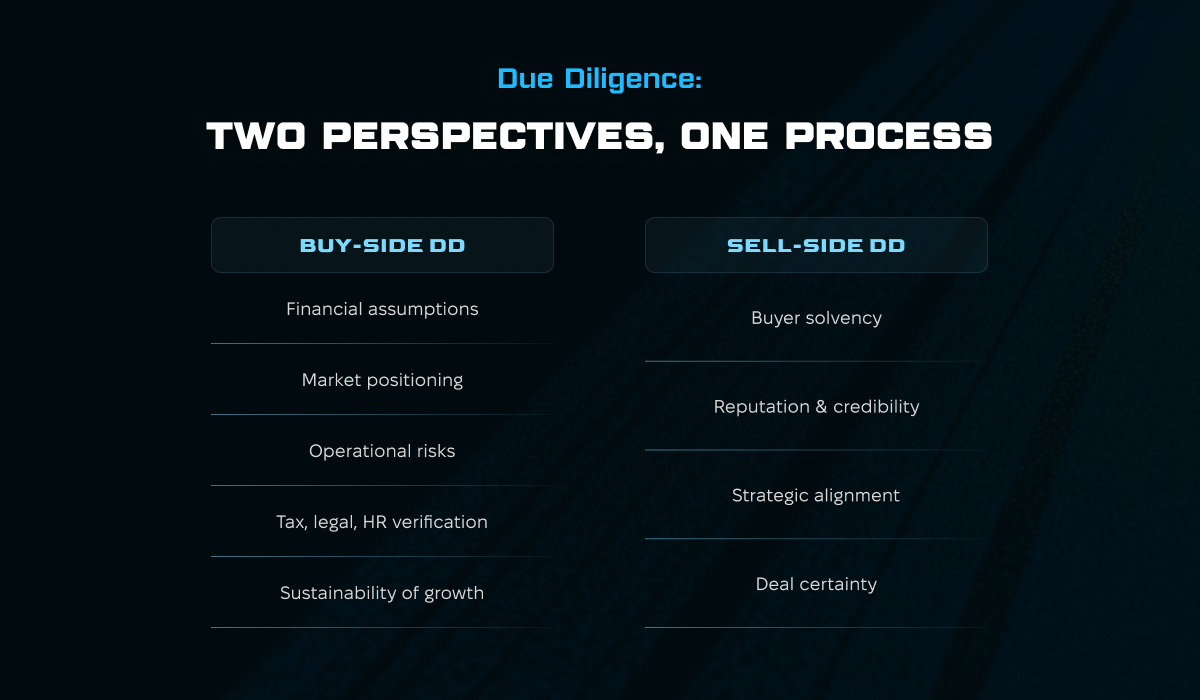
In M&A due diligence, the buy side and sell side approach the same process from completely different angles.
The buy side refers to firms allocating capital – asset managers, or corporate acquirers – and their role is to interrogate every line of the M&A model.
Buy-side research digs into financial assumptions, market positioning, and operational risks, often testing whether debt or equity to finance the deal makes sense under real-world conditions. A buy-side analyst, or even a vice president of equity sales at a major institution, might be involved in questioning whether projected growth is sustainable before a commitment to buy securities is made.
👉Buy-side due diligence also consists of verifying all metrics presented in the sales deck: tax, financial metrics, legal aspects, HR, etc.
The sell side refers to entities positioning a business for sale. Sell-side firms, including banks that work with companies preparing to raise capital, typically organize the data room, build forecasts, and package the company in a way that anticipates scrutiny.
This is where sell-side research analysts and investment banking professionals come into play: they produce detailed equity research and coordinate equity sales at a major bank to make sure a client considering raising equity is seen as an attractive opportunity.
👉Sell-side due diligence, on the other hand, focuses on verifying the investor’s solvency, their brand reputation, and the alignment of values between both parties.
What’s crucial here is that due diligence requires both sides to understand the differences in perspective. The buy side means asking tough questions, while the sell side vs buy side tension is about how much information is disclosed, how it is presented, and whether competitive tension is maintained.
In the end, the difference between the buy-side and the sell-side of M&A is what makes the transaction both adversarial and collaborative.
Benefits of Cooperation With Buy Side / Sell Side M&A Advisors
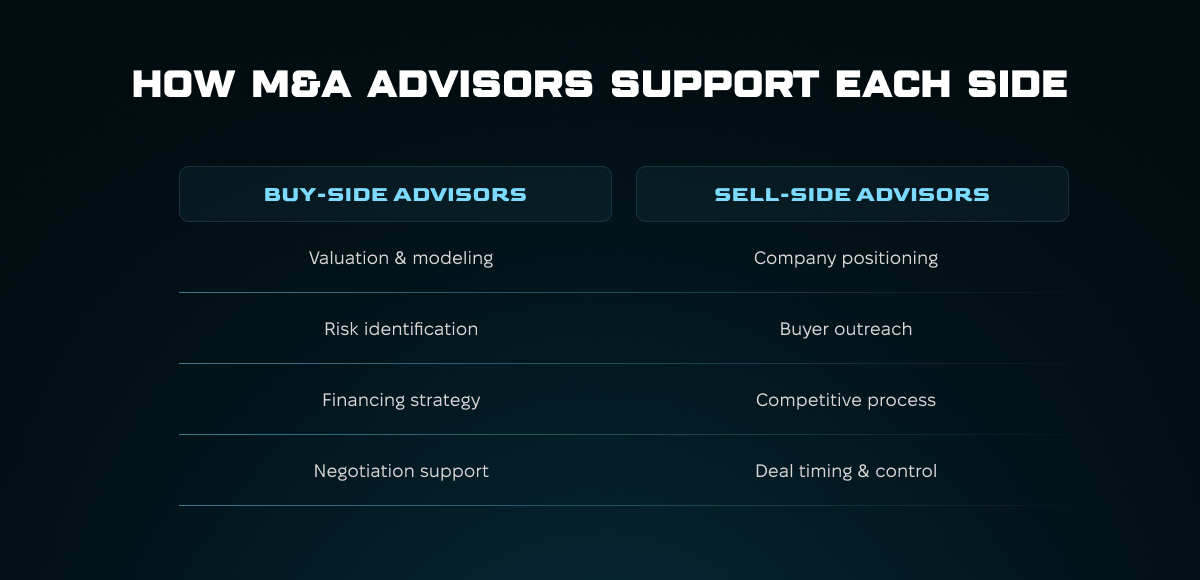
Both sides of an M&A transaction rely heavily on advisors, but in very different ways. On the buy-side, investment banks and advisory firms provide valuation expertise, market context, and negotiation support.
A buy-side firm might lean on its advisors to build and refine an M&A model, conduct industry-specific equity research, or identify financing options through debt or equity capital. For PE firms, which often operate on tight timelines and with high leverage, this external perspective can be the difference between overpaying for an asset and securing a deal that generates long-term returns.
On the sell-side, the role of advisors is equally critical but fundamentally different. Sell-side M&A advisors and investment bankers focus on positioning the company in the best possible light, preparing marketing materials, reaching out to qualified buyers, and orchestrating competitive bidding processes.
Their goal is not only to maximize valuation but also to manage the flow of information and keep the transaction on schedule. A well-run sell-side process often brings multiple buyers to the table, which strengthens the negotiating hand of the seller. In this sense, the relationship between buy-side and sell-side M&A advisory is complementary: one side seeks to uncover hidden risks and extract value, while the other side works to highlight strengths and justify the highest possible price.
Talk to our M&A team to structure your transaction correctly from day one and avoid value erosion disguised as “market reality.”

Key Takeaways
Understanding the differences between buy-side and sell-side in M&A is essential for those in the financial market. In the M&A context, the sell side vs buy side split defines not only motivations but also the tools and language each side uses. Buy-side and sell-side in mergers both rely on debt and equity capital, equity research, and corporate finance expertise, but for different ends.
Sell-side investment banking is designed to market opportunities, coordinate equity sales, and create demand for a company’s securities. Buy-side companies, by contrast, use buy-side research to decide whether those opportunities actually deliver long-term value. Sell-side entities thrive on transactions, while buy-side firms work to protect capital and generate returns.
M&A sell-side advisors aim to maximize valuation, while buy-side professionals aim to avoid overpaying. Both sides are indispensable to how the investment banking industry functions, and both rely on due diligence to bridge the gap between ambition and reality.
FAQ
What is the difference between buy-side and sell-side money?
Buy-side means the institutions, investors, and funds that deploy capital — they’re the ones investing. Sell-side refers to the institutions that provide services, products, or advice to facilitate those investments. For example, in the financial sales and trading world, the sell-side includes investment banks and advisory firms that create liquidity, distribute securities, and provide research to guide investment decisions. On the other side, the buy-side uses that information to decide where money flows.
In mergers and acquisitions, the contrast is clear: the sell-side represents the company that is being sold and works to market it to potential buyers, while the buy-side represents the acquirer, where due diligence and valuation take priority.
What is the difference between Sell side and Buy side roles?
Sell-side vs buy-side structure can be understood through how each is organized. Sell-side refers to investment banks, research providers, and brokerages — all built to serve clients and generate trading activity. Their structure is about scale, distribution, and relationships. The buy-side, by contrast, is structured around investment strategies and portfolios. Hedge funds, asset managers, and PE firms use internal teams — like a buy-side analyst — to review opportunities and decide where to invest. While banks work with companies when a client is considering raising equity, their sell-side structure focuses on packaging and selling those offerings to the buy-side.
What is the difference between Sell side and Buy side roles?
Roles differ sharply. A sell-side analyst produces market insights, equity research, and recommendations. The goal is to influence the buy-side to act. A buy-side analyst, meanwhile, consumes that research and makes actual portfolio or acquisition decisions. In the context of sell-side vs buy-side M&A, the sell-side role is about preparing the business for sale, negotiating with potential acquirers, and managing the process. The buy-side role is about evaluating those opportunities, conducting due diligence, and ensuring the acquisition aligns with long-term strategy. Essentially, the sell-side to the buy-side is about persuasion, while the buy-side role is about selection.
What is the difference between Sell side and Buy side roles?
The motivations between sell-side vs buy-side are rooted in outcomes. The sell-side wants to generate fees, trading activity, and deal flow — that’s why the sell side of the financial sales and trading puts so much emphasis on research and execution. The buy-side, in contrast, is motivated by investment returns. In sell-side vs buy-side M&A, this plays out as advisors on the sell-side aiming to secure the best price and terms for their client, while buy-side advisors aim to acquire value without overpaying. When banks work with companies and a client is considering raising equity, the sell-side motivation is to complete the offering successfully, while the buy-side motivation is to find the right opportunity at the right valuation.
#M&A
#buy
#sell
#web3
Share this post
Ready to grow?
With our M&A expertise we are ready to help you achieve your strategic goals!
Connect with us